Racial Framing and Messaging In the Media
Racial Framing and Messaging in the Media
If we only say “crime, welfare, and unemployment” when talking about Black people, then people will only associate those things with Black people. Doing this creates a negative emotional reaction whenever someone mentions a Black person. According to the Census, 11% of Black people are unemployed — which means that regardless of how many Black people receive welfare, the overwhelming majority of Black people are working people who earn a living.
Bureau of Labor Statistics
According to the Bureau of Justice Statistics, the incarceration rate for Black people has decreased sharply. For proper context, it is worth noting that it has increased for white people — so one does not get the false impression that incarceration simply decreased across the board for everyone.
New York Times / Bureau of Justice Statistics
It is long overdue for us to talk about positives when we discuss Black people. Most people cannot name a single positive stereotype about Black Americans — probably because there aren’t any widely held ones. Since there aren’t, can anyone name positive facts that contradict the false stereotypes? Or name great accomplishments the Black community as a whole has achieved? In the media, audiences are consistently reinforced with positive portrayals of white society — much of which is driven by population numbers. Being 70% of the population, the media naturally caters to that group across magazines, Hollywood, and elsewhere.
For example, there is an all-Black college prep school in Chicago that has achieved 100% college acceptance for five consecutive years. We hear about Chicago constantly in the media since Obama became president, yet I have seen this story covered at an extremely low frequency — so low I can barely track it.
Chicago College Prep: 100% College Acceptance
Speaking of college — Black women have surpassed all racial groups of both genders in college enrollment.
Black Women’s College Enrollment
After leaving high school, Black women have begun to dominate higher education. Though all women lead their male counterparts in college enrollment and degree attainment, Black women do so at higher rates than any other group of women in America. In 2010, they represented 66% of all Black people who completed a Bachelor’s degree, 71% with a Master’s degree, and 65% with a Doctorate. Their achievements continue after graduation as well. Black women lead all women in labor force participation rates — a pattern that has held true even after they become mothers. They are also highly entrepreneurial, starting businesses at six times the national average and representing the fastest-growing segment of women-owned businesses. Black women own more than one million firms, employ 272,000 people, and generate an estimated $44.9 billion in revenue.
— Think Progress
According to the Census Bureau, Black-owned businesses have grown at triple the national rate.
Census Bureau
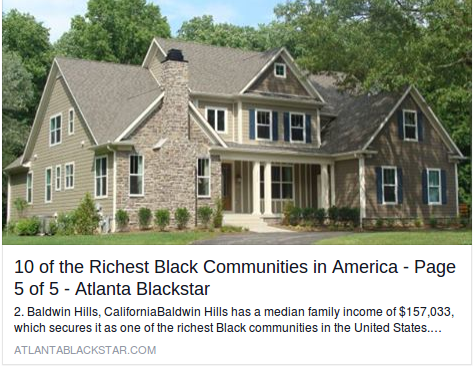
Why do people only bring up Ben Carson or the Obamas as success stories — one or two individuals — while never discussing the all-Black school with a 100% college acceptance rate? Or the Black communities across the United States with median household incomes between $70k and $156k per year? Those entire neighborhoods deserve to be part of the conversation, not just the latest fixation on a single person. By only ever mentioning one individual, it creates the false impression that everyone else in that group is a failure — while ignoring the large and thriving blocks of successful Black communities. Here is the list along with their median incomes:
- View Park-Windsor Hills, California — $159,168
- Baldwin Hills, California — $157,033
- Ladera Heights, California — $132,824
- Mitchellville, Maryland — $118,022
- Fort Washington, Maryland — $114,243
- Kettering, Maryland — $107,008
- Woodmore, Maryland — $103,438
- Friendly, Maryland — $82,827
- Hillcrest, New York — $76,960
- Uniondale, New York — $76,553
Top 10 Richest Black Communities
We have to change how we talk about these things. If we debate and discuss these issues only within the false framing the media has established, we will continue to prop up the false racial stereotypes that the media and political elites have conditioned all of us to use. The moment someone frames the conversation exclusively around “crime, unemployment, or out-of-wedlock births,” they are unwittingly doing the media’s work for them.
If someone truly wants to combat racism, one major component is changing how society perceives Black people. As soon as someone starts pushing the familiar media talking points about out-of-wedlock births, Chicago crime rates, Detroit, or intra-racial crime, counter with this:
Black unemployment is only around 10%, meaning that whatever Black people are receiving welfare are most likely also working. But have you seen the wealthiest Black communities in the United States? And that is just the top ten — there are many more below them in the $50k to $60k range, with some reaching $159k per year. And Black-owned businesses have grown at triple the national rate.
Regardless of the person’s race — Black or white — they will likely be surprised by these facts, because this is not what the media or their political sources have told them.
Those who depend on negative racial stereotypes may respond with hostility to this information and accuse you of being in denial. This person has been so thoroughly conditioned that it would be the envy of any computer programmer. This is how racism lives and is perpetuated — not just through obvious bigots, but through good, honest people of all races who unknowingly prop up the racist framing machine in the media. Once people understand that it is not only overt racists but well-meaning people of every background who sustain this system through how they think and speak, we will be much closer to understanding how a group can be kept down socially — not through force alone, but through the power of language and perception.
also posted on facebook here
Edit: 8-9-2018
Number of Black-Owned Businesses Grows, Challenges Remain
Racial Gap In U.S. Jails Narrows As White Incarceration Rates Rise and Black Imprisonment Declines